How to Evaluate an AC Adapter Supplier for Quality and Certifications?
An AC/DC power adapter is an external device that converts alternating current (AC) electrical power from a mains supply into a regulated direct current (DC) needed by electronic components, and selecting the right ac adapter supplier is critical because an inferior power source can degrade hardware life, trigger safety issues, and compromise your brand’s market entry. Imagine launching a breakthrough electronic device, only to face widespread product returns, costly customs delays, and negative reviews due to sudden power supply failures. This headache is often caused by relying on uncertified, low-quality components that cannot handle voltage variations or thermal demands. Fortunately, sourcing from a dedicated, certification-ready manufacturer provides the exact engineering precision and regulatory approvals you need to keep your production and distribution moving seamlessly.
How to select a certified ac adapter supplier?
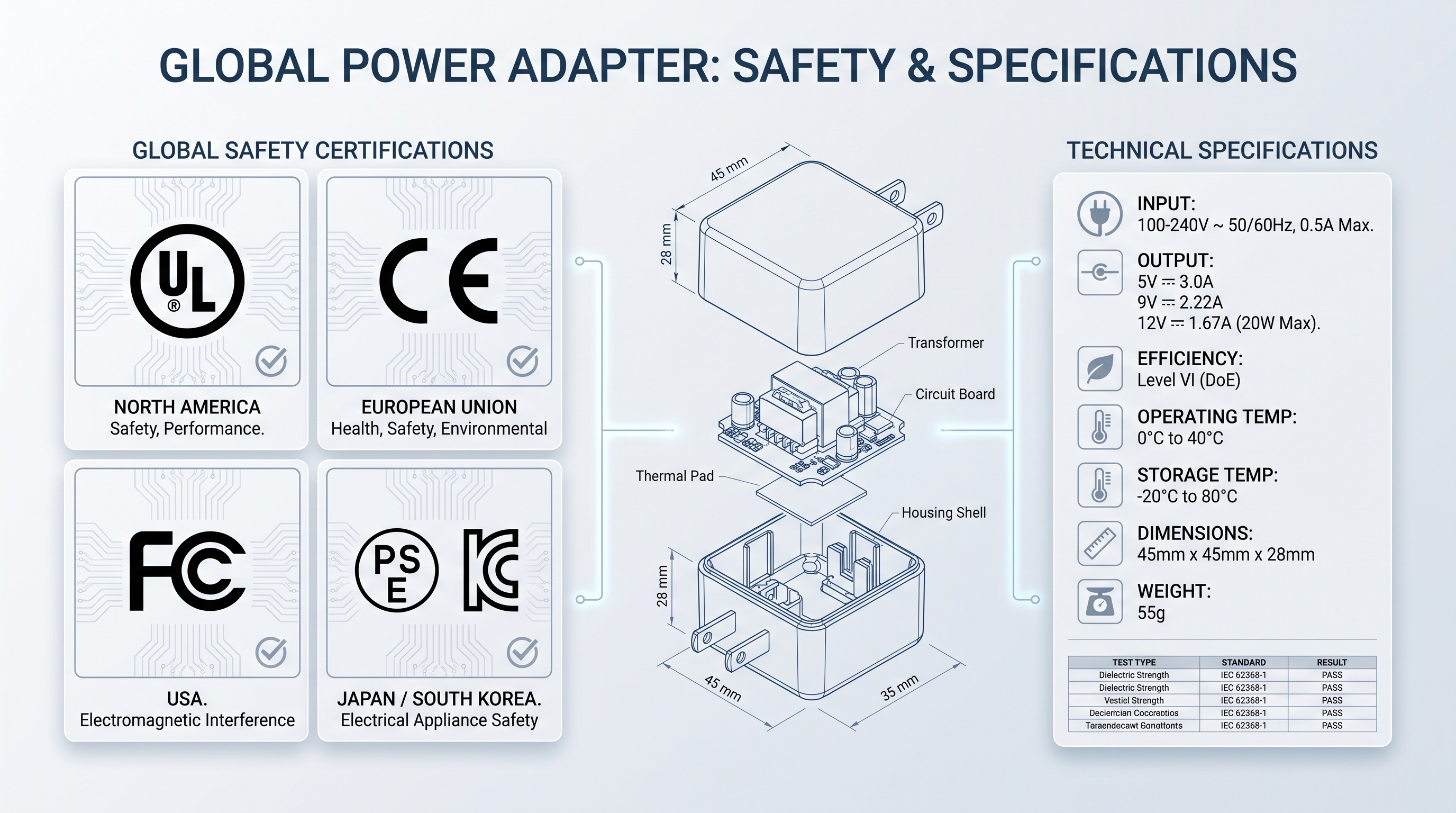
You can select a certified partner by auditing their active compliance database to ensure they hold updated UL, CE, GS, KC, and PSE certifications that cover your target markets. Partnering with a certified ac adapter supplier protects your business from costly product recalls and immediate customs rejections.
Experienced manufacturers will gladly provide official certificate registration numbers for verification on regulatory databases. Taking this verification step guarantees that your power solutions are fully compliant and ready for global markets.
Why are global safety certifications critical?
Without strict safety certifications, your electronic devices risk dangerous overheating, electrical fires, or high-voltage leakage that can harm your users. Think about it: a single power surge could fry your device’s motherboard, resulting in expensive warranty claims and brand damage. You must ensure your equipment matches safety rules.
Here are the primary certifications you need to target:
-
UL/cUL: Mandatory for safe and legal sale across the North American market.
-
CE & GS: Crucial for complying with low-voltage and safety directives in the European Union.
-
KC & KCC: Essential for entering South Korea’s strict telecommunications and tech industries.
What is the business utility of certified power?
Using certified power supplies directly improves your brand’s market speed and reduces potential legal liabilities. The best part? You can bypass difficult testing bottlenecks when seeking complete system-level approvals for your final product.
Key Takeaway: Standardizing on fully certified power supplies minimizes legal risks, speeds up customs clearances, and secures your place in highly regulated global markets.
| Certification | Primary Market | Core Standard | Testing Objective |
|---|---|---|---|
| UL 62368-1 | North America | ITE & AV Safety | Fire prevention and thermal testing |
| CE (LVD/EMC) | Europe | Safety & Emissions | Low-voltage compliance and EMI suppression |
| KC (K62368-1) | South Korea | Electrical Safety | Grid isolation and shock hazard checks |
Utilizing this comparative matrix helps you cross-reference different regional safety marks to align your supply chain with target markets.
What does a custom ac adapter supplier offer?

A custom manufacturer offers tailored electrical specifications, bespoke casing shapes, and specialized connectors designed to fit your device’s unique footprint and power demands. Working with a dedicated custom ac adapter supplier ensures your device receives optimized voltage levels and clean power.
These engineering teams can build customized solutions with wide input voltage ranges and variable current outputs. Having this design control allows your product engineers to achieve maximum hardware efficiency.
Can you get custom voltage and current outputs?
You can customize output voltages anywhere from 3V to 56V and scale current levels to match your exact PCB requirements. But here is the catch: off-the-shelf power options often force you to adjust your board’s power rail design, which can lower overall efficiency.
-
Custom Voltage steps: Optimize output levels down to the decimal point to match sensitive components.
-
Variable Current limits: Prevent over-current damage while ensuring reliable startup power.
-
Custom Cable designs: Choose exact wire lengths, wire gauges, and specialized locking jacks.
How does custom branding improve your product?
Customizing the adapter shell with your company logo and matching color schemes improves your overall brand presentation. You can even choose compact wall plug designs that do not block adjacent outlets on standard power strips.
Key Takeaway: Custom power engineering allows your team to focus on core product design, knowing that your power supply matches your exact technical and aesthetic specifications.
| Custom Option | Industrial Benefit | Typical Range | Application Focus |
|---|---|---|---|
| Voltage Tuning | Eliminates onboard regulators | 3.0V – 56.0V DC | Sensitive IoT & telecom boards |
| Mold Customization | Unique shapes and branding | Slimline / Angled | Space-constrained wall sockets |
| Connector Selection | Prevents accidental pull-outs | Locking barrel / USB-C | Medical devices & smart home hubs |
This breakdown illustrates how customized features help you improve both structural integration and overall device reliability.
Why trust an OEM-direct ac adapter supplier?
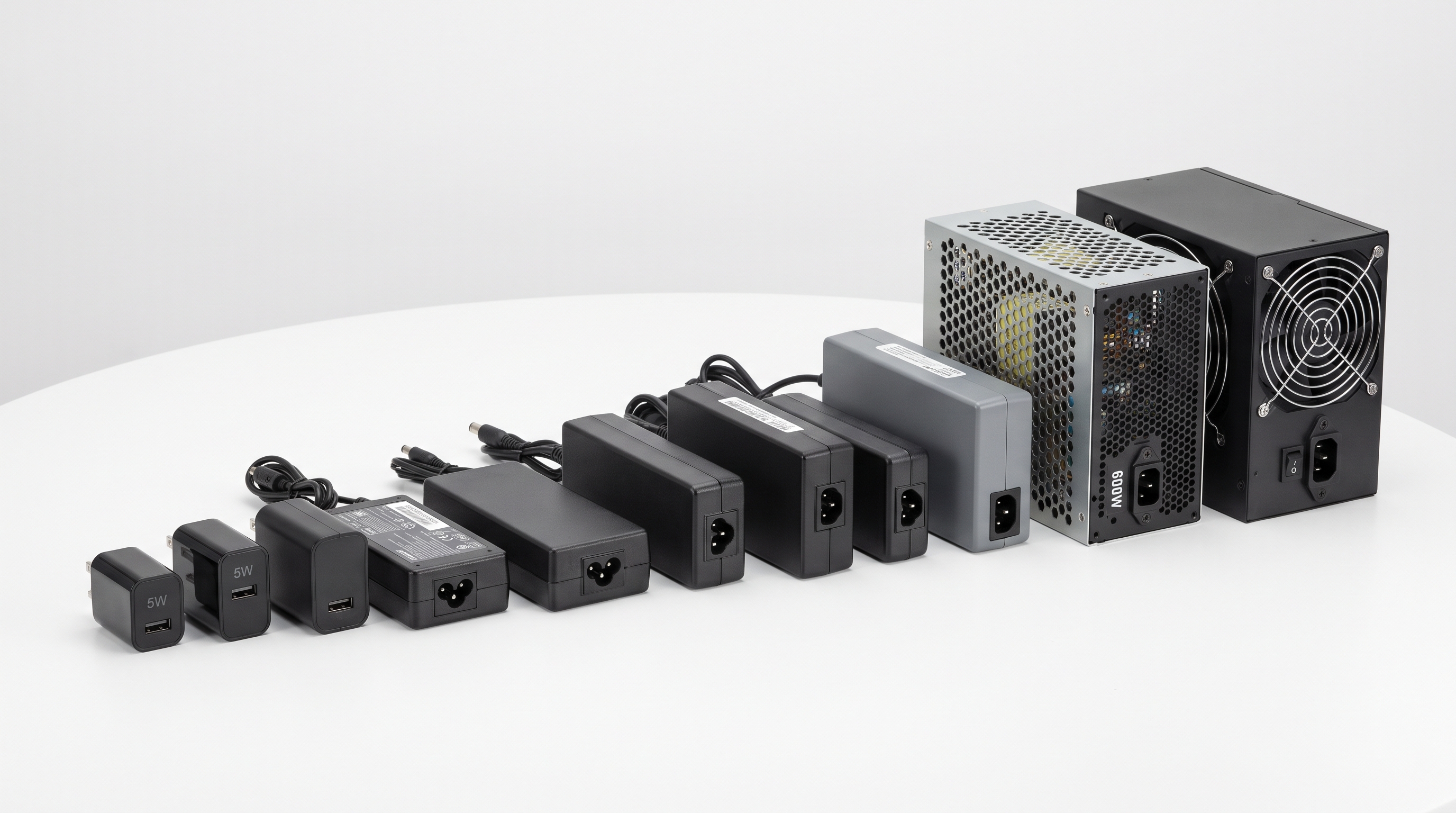
Sourcing direct from the manufacturer guarantees transparent pricing, raw material tracking, and direct access to the design engineering team. By partnering with an OEM-direct ac adapter supplier, you eliminate middlemen markups and maintain complete control over production schedules.
Trading companies often hide key manufacturing details and struggle to guarantee consistent component quality across different batches. Direct factory access gives you peace of mind and keeps your production schedules running smoothly.
What are the financial perks of direct sourcing?
You will see immediate cost reductions on bulk orders because you are avoiding the added markup of trading agents. Here is the deal: purchasing directly from the factory floor maximizes your profit margins and provides stable wholesale pricing.
-
Lower per-unit cost: Save significantly on high-volume production runs.
-
No broker fees: Ensure every dollar spent goes directly into product quality and assembly.
-
Direct volume scaling: Unlock steeper discounts as your production volume expands.
How does direct engineering communication help?
Working directly with the factory’s engineering team means design modifications or troubleshooting are resolved in hours rather than weeks. This direct line of communication prevents critical misunderstandings and speeds up prototype development.
Key Takeaway: Direct manufacturer partnerships give you complete control over your supply chain, stable pricing, and direct technical support to keep your project moving forward.
| Sourcing Route | Cost Structure | Quality Traceability | Engineering Support |
|---|---|---|---|
| OEM Direct | Low (Factory cost) | Complete component trace | Real-time, direct access |
| Trading Company | High (Broker markup) | Limited or zero visibility | Delayed multi-stage communication |
Comparing direct and indirect sourcing models shows that factory-direct partnerships offer superior control over quality, lead times, and overall costs.
How to evaluate your ac adapter supplier factory?

You can evaluate a production facility by inspecting their automatic SMT assembly lines, testing equipment, and thermal burn-in chambers. Vetting your ac adapter supplier factory ensures that your mass-produced units are built with consistent, repeatable quality.
High-quality factories invest heavily in automation to eliminate human assembly errors and ensure consistent performance. A physical or virtual factory tour will quickly reveal their commitment to quality.
What equipment signals high manufacturing standards?
You should look for automated manufacturing equipment like modern pick-and-place systems and Automated Optical Inspection (AOI) units. Think about it: manual soldering cannot match the precision of an automated line, especially when producing thousands of units.
-
SMT Pick-and-Place: Ensures perfect component alignment on every PCB.
-
AOI Systems: Instantly flag cold solder joints and misaligned parts before assembly.
-
Chroma Testers: Automatically verify output parameters under varying electrical loads.
Why is the 100% burn-in test essential?
Every single adapter should undergo a multi-hour burn-in test under full load to screen out early component failures. This intensive stress-testing process forces weak components to fail at the factory rather than in your customer’s hands.
Key Takeaway: Thoroughly auditing a supplier’s automation and testing systems is the most effective way to protect your product launch from unexpected field failures.
| Production Stage | Automation Level | Machinery Used | Quality Impact |
|---|---|---|---|
| PCB Assembly | Fully Automated | SMT & Wave Soldering | Eliminates human component placement errors |
| Verification | High-Definition | AOI & Chroma Loads | Catches electrical and physical flaws early |
| Stress Testing | 100% Coverage | Thermal Chambers | Screens out early-stage capacitor failures |
Vetting this manufacturing equipment proves that high-quality automated testing is key to maintaining low defect rates in bulk shipments.
What to ask your local ac adapter supplier?
You must ask about minimum order quantities, production lead times, and raw material safety stocks to ensure they can scale with your business growth. Clarifying these terms with your ac adapter supplier prevents costly supply bottlenecks and production delays.
Getting clear written agreements on delivery schedules and inventory buffers helps you plan your product launches with confidence. Reliable partners will offer transparent terms to support your product’s lifecycle.
What are standard MOQ and lead time terms?
You should look for flexible starting MOQs that let you scale up safely from initial pilot programs to mass production. But here is the catch: ultra-low MOQs can sometimes lead to higher per-unit costs, so finding the right balance is key.
-
Prototype MOQs: Help you verify design compatibility with minimal up-front cost.
-
Production Lead Times: Usually run between 3 to 5 weeks for standard custom models.
-
Inventory Buffers: Keep emergency stocks on hand to prevent unexpected assembly line shutdowns.
How do safety stock agreements protect you?
Setting up safety stock agreements ensures your manufacturing partner keeps key components on hand for fast assembly. This setup protects your business from global raw material shortages and sudden shipping delays.
Key Takeaway: Setting clear terms for MOQs, lead times, and safety stocks creates a highly resilient supply chain that easily adapts to shifting market demands.
| Agreement Clause | B2B Procurement Target | Potential Risk | Operational Benefit |
|---|---|---|---|
| Initial MOQ | 500 – 1,000 Units | High up-front cash ties | Lower entry costs for product tests |
| Standard Lead Time | 21 – 30 Days | Market delays and backorders | Predictable production schedules |
| Safety Stock Buffer | 10% of annual forecast | Unexpected shipping halts | Continuous, uninterrupted supply |
Utilizing this supply framework ensures you maintain tight control over inventory costs while shielding your assembly lines from supply gaps.
How does an ac adapter supplier ensure safety?

An experienced manufacturer ensures safety by incorporating active protection ICs, high-grade insulation barriers, and optimized PCB spacing into every design. Partnering with a safety-conscious ac adapter supplier protects your users and devices from dangerous electrical surges.
High-quality designs isolate high-voltage mains from your device’s low-voltage circuits. This meticulous engineering prevents electrical shocks, fires, and premature hardware failure.
What are the key active protection circuits?
You need built-in protection circuits that instantly shut down power delivery if voltage, current, or temperature spikes beyond safe limits. Think about it: active protection acts as a reliable shield, keeping common power grid problems from frying your hardware.
-
Over-Voltage Protection (OVP): Clamps high voltage spikes to protect delicate chips.
-
Short-Circuit Protection (SCP): Instantly cuts power if cables are damaged, preventing fires.
-
Over-Temperature Protection (OTP): Safely turns off the adapter if internal heat rises too high.
How does creepage distance prevent shocks?
You must verify that the PCB layout meets strict creepage and clearance distance rules to keep high voltage from jumping across isolation boundaries. Proper physical spacing ensures safe operation even in humid or dusty environments.
Key Takeaway: Choosing a supplier that uses active protection systems and strict physical spacing ensures your devices run safely and remain compliant.
| Protection System | Trigger Condition | Adapter Response | Safety Benefit |
|---|---|---|---|
| Over-Voltage (OVP) | Voltage rises 120% above nominal | Shuts down PWM controller | Protects device microchips |
| Short-Circuit (SCP) | Output resistance drops near zero | Enters “hiccup” safe mode | Prevents overheating and melting |
| Creepage Barrier | High-voltage PCB track proximity | Physical 8.0mm air gap | Eliminates risk of user shocks |
Using this multi-layer safety approach ensures your final product complies with international electrical safety standards.
When to change your global ac adapter supplier?

You should change your supplier when you experience rising field failure rates, consistent delivery delays, or unhelpful, slow-response customer support. Transitioning to a certified global ac adapter supplier protects your business from costly product downtime and rising warranty claims.
Underperforming suppliers who use low-grade internal components can damage your brand’s market reputation. Making the switch ensures you maintain high quality and reliable delivery.
What are critical red flags in product quality?
You should watch out for chronic quality issues like loose internal soldering, high-pitched coil buzzing, or weak cable strain reliefs. By the way, these warning signs point to poor factory quality control and cheap components.
-
Cheap Capacitors: Cause early adapter failures, typically within the first year of use.
-
Loud Coil Whine: Signals poorly wound or unglued transformer parts, which frustrates users.
-
Weak Strain Reliefs: Lead to broken copper wires and sudden power loss under normal use.
How do you transition with zero downtime?
You can transition smoothly by building a temporary safety stock of your current adapters while testing and certifying your new partner. This overlap keeps your assembly lines moving and avoids product launch delays.
Key Takeaway: Spotting quality issues early and planning a phased supplier transition protects your product line from expensive downtime and bad user experiences.
| Quality Red Flag | Root Factory Failure | Commercial Risk | Transition Action |
|---|---|---|---|
| Spiking Field Failures | Low-grade capacitors used | High warranty claims | Switch to a certified Tier-1 supplier |
| Loud Buzzing Noises | Poor transformer winding | Low brand perception | Demand vacuum-varnished assemblies |
| Frayed Output Cables | Cheap PVC or strain relief | Fire and shock hazards | Upgrade to thick AWG cable jackets |
Monitoring these quality metrics helps you decide when to replace underperforming vendors to protect your brand.
Why is efficiency key for an ac adapter supplier?

High-efficiency power supplies minimize wasted energy, lower operating temperatures, and meet strict international environmental rules. Selecting a highly efficient ac adapter supplier helps you save energy and prolongs your product’s service life.
Inefficient adapters waste electricity as heat, which speeds up the aging of critical internal parts. Choosing high-efficiency designs ensures your equipment runs cool and lasts much longer.
What is Energy Efficiency Level VI?
You must ensure your power supplies comply with Energy Efficiency Level VI standards, which limit both standby power draw and active mode efficiency. The best part? These high efficiency levels help you meet strict energy regulations in major global markets.
-
Minimal Standby Draw: Keeps idle power consumption below 0.1 Watts to save energy.
-
High Active Efficiency: Maximizes power conversion to keep adapters running cool.
-
Eco-Friendly Design: Meets tough environmental standards like European CoC Tier II.
How does cooler operation extend hardware life?
You will see much better product reliability because cooler operating temperatures reduce thermal stress on sensitive internal capacitors. This thermal design ensures your power systems deliver consistent, stable output over years of continuous use.
Key Takeaway: Sourcing high-efficiency adapters ensures you comply with global environmental laws while improving device life and reducing field returns.
| Standard Level | Max Idle Power Draw | Target Efficiency | Main Target Market |
|---|---|---|---|
| DoE Level VI | < 0.100 Watts | High curve scaling | United States & Canada |
| CoC Tier II | < 0.075 Watts | Ultra-high curve | European Union |
Choosing Level VI or CoC Tier II compliant supplies protects your products from future energy-use restrictions.
Which regulations must an ac adapter supplier pass?
A reliable manufacturer must comply with global environmental and electromagnetic interference standards like RoHS, REACH, and FCC. Choosing a compliant ac adapter supplier prevents environmental fines and avoids interference issues in the field.
These standards ensure that your power supplies do not contain hazardous materials or emit disruptive radio frequency noise. Meeting these requirements is key to passing customs audits and keeping your hardware running smoothly.
Why are RoHS and REACH directives vital?
You must confirm that every power supply is free of hazardous substances like lead, mercury, and cadmium to comply with RoHS and REACH. Think about it: using non-compliant components can lead to heavy environmental fines and custom bans in Europe.
-
Lead-Free Soldering: Prevents toxic metals from contaminating soil and water.
-
Phthalate-Free Cables: Ensures that external plastic cables are completely safe for users to handle.
-
Full Supply Traceability: Confirms that all raw materials comply with green manufacturing guidelines.
How does EMC testing prevent interference?
You should verify that your adapters pass FCC Class B and CISPR standards to ensure they do not disrupt wireless signals or nearby electronics. Proper electromagnetic compatibility (EMC) shielding keeps your device running cleanly without signal static.
Key Takeaway: Partnering with an environmentally compliant manufacturer keeps your hardware legally clean, safe for users, and ready for immediate global distribution.
| Regulation | Focus Area | Hazard Preventive | Compliance Value |
|---|---|---|---|
| RoHS | Hazardous Chemicals | Lead and cadmium bans | Mandatory for European market access |
| REACH | Chemical Security | Plasticizer toxin checks | Guarantees safe everyday handling |
| FCC Part 15 | Wireless Emissions | Radio frequency static | Prevents interference with Wi-Fi signals |
Using this regulatory checklist ensures your hardware conforms to the latest environmental laws.
How to align with a B2B ac adapter supplier?

You can align with a B2B partner by setting clear Service Level Agreements, holding regular quality reviews, and collaborating on early design stages. Working closely with your ac adapter supplier secures priority manufacturing space and responsive engineering support.
Treating your manufacturer as a long-term partner rather than a simple vendor results in better support and more flexible pricing. This collaborative relationship keeps your supply chains stable and highly competitive.
How to establish strong SLA quality targets?
You should define clear performance and quality metrics, like targeting a low Parts Per Million (PPM) defect rate. Here is the deal: setting clear SLA standards up front ensures your partner remains focused on delivering excellent quality.
-
Strict Defect PPM Caps: Target under 100 PPM to ensure consistently high batch quality.
-
On-Time Delivery Targets: Ensure at least a 98% on-time shipping record to keep assembly moving.
-
Fast Response Times: Require technical support answers within 24 hours to resolve issues quickly.
Why is early co-development beneficial?
Involving your supplier’s engineering team early in your product design process prevents costly mechanical and electrical conflicts later on. Designing the power system alongside the main hardware leads to a better-optimized, more reliable device.
Key Takeaway: Building a collaborative B2B partnership secures priority production space, direct engineering support, and steady pricing over your product’s lifecycle.
| Collaboration Level | Target Defect Rate | Lead-Time Priority | Design Resource Access |
|---|---|---|---|
| Transactional Buyer | > 1,000 PPM | Standard queue wait | Limited, basic support |
| Strategic B2B Partner | < 100 PPM | Priority scheduling | Direct, active engineering access |
Moving toward strategic B2B partnerships secures your supply chain and improves overall hardware quality.
Consumer-Centric FAQs
Can I use a higher amperage power adapter than specified on my electronic device?
Yes, you can. Your electronic device will only pull the specific current (amperage) it needs from the adapter, so a higher amperage rating will not damage it. However, you must ensure that the voltage matches your device’s input requirements exactly to prevent electrical damage.
What’s the best way to determine the plug polarity of an AC/DC adapter?
The best way is to look at the polarity symbol printed on the adapter’s technical label. This symbol consists of three circles showing whether the center pin is positive + or negative -. For absolute accuracy, you can also use a digital multimeter to measure the direct current voltage at the output plug.
Center-Positive: ( - ) ----( • )---- ( + )Center-Negative: ( + ) ----( • )---- ( - )
How do I know if my AC/DC power adapter is failing?
You can identify a failing power adapter by checking for key physical and operational warning signs. Look for bulging plastic casing, excessive heat, or frayed output cables. If you hear a high-pitched squealing noise or notice flickering LEDs on your connected device, the internal capacitors are likely failing.
Can I use an interchangeable plug adapter for international shipments?
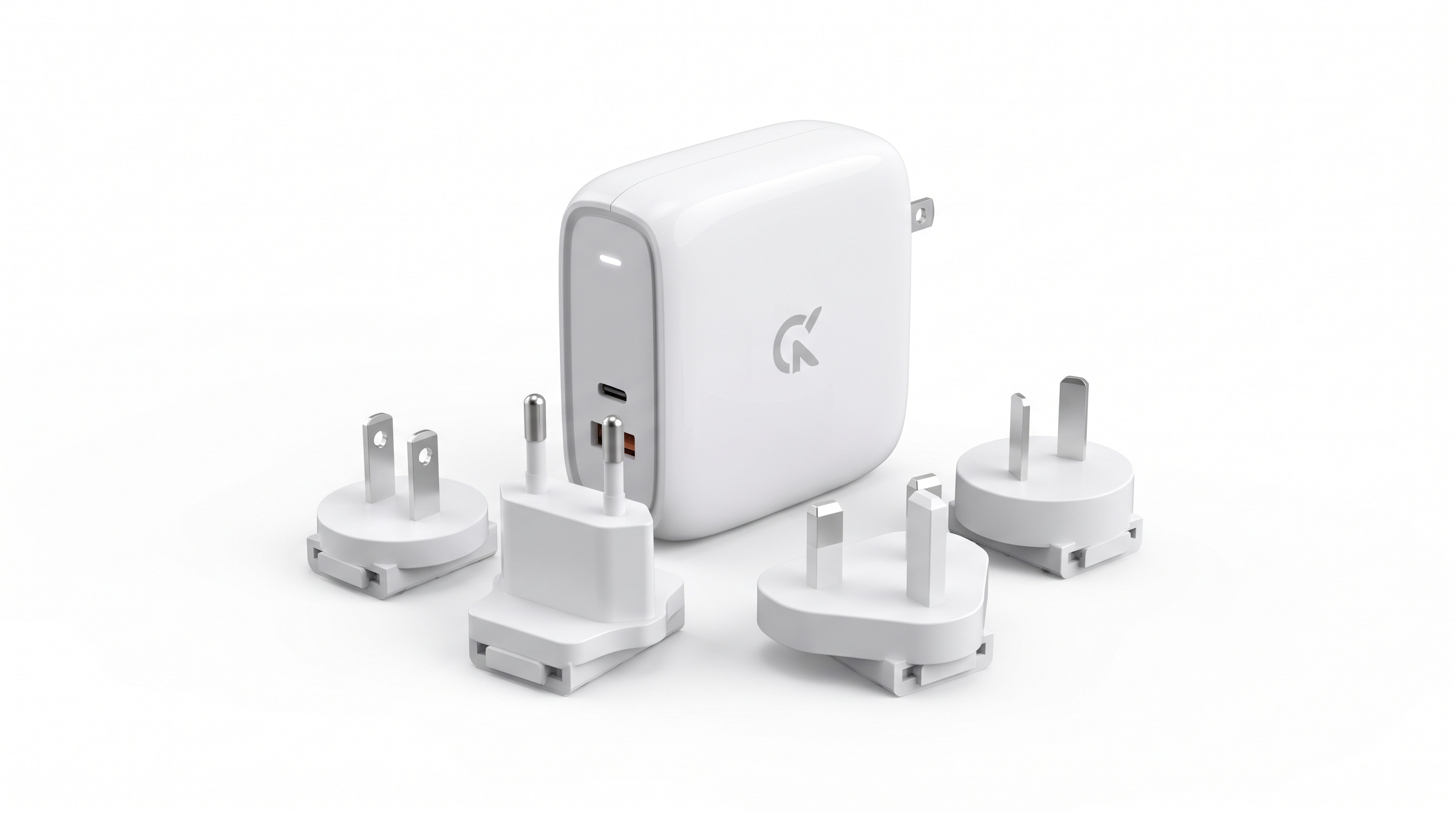
Yes, you can use interchangeable plugs to simplify global shipping. This platform lets you swap regional wall plugs (US, EU, UK, AU) onto a single universal power supply body. It eliminates the need to manage multiple regional adapter models, reducing your inventory complexity.
How do I know if a desktop-style adapter is better than a wall-mount adapter for my hardware?
Yes, a desktop-style adapter is typically better if your device requires higher power outputs (usually above 36W to 65W) or must fit into tight outlet spaces. Wall-mount adapters are great for compact, low-power devices, but their bulky bodies can sometimes block adjacent outlets on power strips.
Conclusion
Selecting the right power adapter is a fundamental step in ensuring your electronic hardware operates safely and efficiently in global markets. Partnering directly with a certified, OEM-capable manufacturer gives your team access to specialized custom engineering, high-tech testing automation, and priority supply line scheduling. If you need help tailoring a power solution or would like to request customized samples for your next project, contact us today to collaborate with our engineering team. We are dedicated to delivering stable, world-certified power solutions that fuel your technology and secure your brand’s long-term success.