Tips for Negotiating Terms with Your Power Adapter Supplier

Understanding Cost Structures and Production Economics
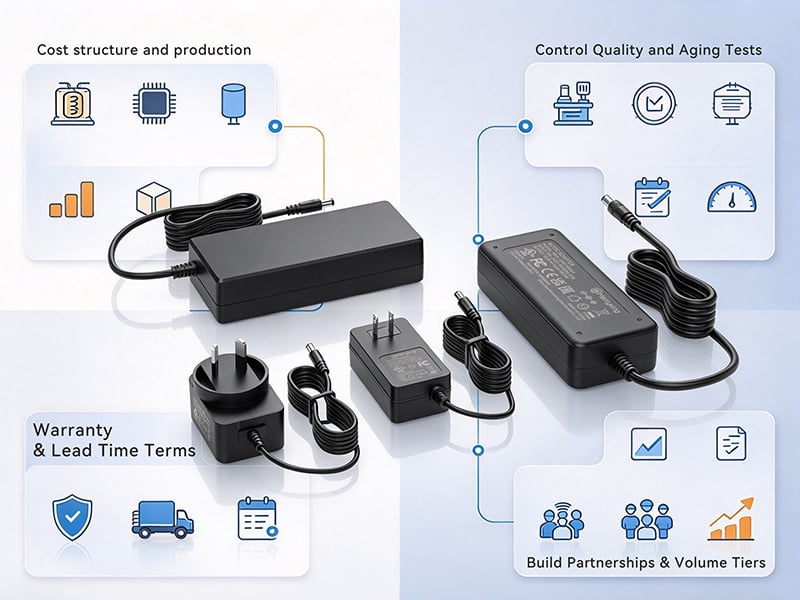
When entering commercial negotiations with a power adapter supplier, achieving a successful and sustainable agreement requires a careful balance between cost efficiency, product reliability, and operational transparency. Professional procurement teams must first understand the underlying manufacturing expenses, including core electronic elements like high-frequency transformers, control integrated circuits, and electrolytic capacitors, while evaluating tiered volume pricing and Minimum Order Quantities (MOQs). By establishing clear volume thresholds, buyers can align their inventory planning with factory output capabilities without facing unexpected financial surprises or margin erosion. Furthermore, understanding how raw material cost fluctuations impact baseline production allows purchasing agents to negotiate fairer price adjustments during volatile market cycles rather than accepting arbitrary increases from overseas factories. Transparent cost breakdowns also open the door for collaborative cost-reduction initiatives, such as standardizing enclosure molds or utilizing shared component platforms across multiple device models, which ultimately benefits both parties' long-term profitability and market competitiveness.
Managing Quality Control and Aging Test Commitments
Price negotiations should never compromise critical safety standards, regulatory compliance, or long-term operational performance. A trustworthy power adapter supplier must commit to rigorous internal quality management protocols, such as executing a mandatory 100% full-load aging test on every finished unit and performing comprehensive Acceptance Quality Limit (AQL) sampling inspections prior to shipment. Tying unit prices directly to these stringent testing requirements ensures that your production batches maintain high electrical efficiency, minimal ripple, and superior thermal stability. This proactive approach prevents high field return rates, reduces costly warranty claims, and protects your brand reputation in highly regulated target markets where electronic safety certifications are paramount. Additionally, negotiating clear inspection protocols means that third-party testing reports or factory test logs must accompany every commercial invoice, providing an uncompromised audit trail for your internal quality assurance department and regulatory bodies alike.
Clarifying Warranty Policies and Delivery Lead Times
Equally critical to the negotiation process is the precise definition of after-sales terms, warranty coverage periods, and delivery timelines. A comprehensive supply agreement must clearly outline procedures for handling defective units, specifying whether immediate replacements or future credits will be issued, alongside realistic production lead times that factor in seasonal market fluctuations and material lead times. Establishing transparent accountability measures for delivery schedules fosters a stable, long-term collaboration with your power adapter supplier, ensuring seamless supply chain execution from initial prototype approval to mass production runs. Defining these legal and operational boundaries early eliminates ambiguity when unexpected logistics bottlenecks arise, such as global shipping container shortages or port congestion. Contracts should also include explicit penalty clauses or grace periods for delayed shipments, ensuring that the factory maintains high prioritization for your purchase orders even during peak global manufacturing seasons.
Structuring Long-Term Partnerships and Volume Tiers
Securing sustainable commercial success goes beyond single-batch transactions and relies heavily on structured multi-tier framework agreements. Buyers should closely collaborate with their power adapter supplier to forecast annual volume requirements, enabling both parties to optimize bulk material purchasing and minimize overhead factory expenses. Long-term contracts that incorporate predictable scaling benefits, clear engineering change-management protocols, and dedicated technical support ensure that your supply chain remains resilient, cost-effective, and fully capable of scaling alongside your future product expansions and next-generation device roadmaps. When suppliers know they have a reliable, multi-year partnership, they are far more likely to allocate their best engineering talent, reserve priority production capacity, and offer preferential pricing tiers that give your brand a distinct competitive edge in the global marketplace.